
Leadership Strategy Scan
Surface the patterns and habits that shape how you lead day-to-day
At some point, every leader hits a moment where the usual approach stops working.
You're experienced, you've handled hard things before, and then something shifts — a new role that feels nothing like the one you prepared for, feedback that lands harder than expected, a team that isn't gelling, an organisational change that arrives faster than anyone can think straight. Suddenly you find yourself off script — the instincts and habits that have served you well feel like they're working against you.
These moments aren't a sign that something is wrong with you. They're a normal part of leading at any level — and they're becoming more frequent. AI alone is compressing timelines, multiplying decisions, and introducing a level of organisational noise that no playbook was built for. The leaders I work with aren't struggling because they lack skill or experience — they're struggling because the situation has moved faster than their self-awareness has.
That’s what this scan is for.
Every leader operates from an internal playbook — a mix of habits, defaults, and patterns built up over years. Most of us didn't design it consciously. It formed through the managers who shaped us, the cultures that rewarded certain behaviours, and the experiences that taught us what felt safe. And it works — until the conditions change enough that it doesn't. Until you find yourself off script.
This scan makes those patterns visible. It's most useful as a baseline — a clear picture of how you habitually lead, so that when an off-script moment arrives, you know what you're starting from.
The five dimensions in this scan are where your leadership patterns show up most visibly.
How you're spending your time.
What you're taking on (and what you’re not).
How you're making decisions under pressure.
How you communicate when you don't have the answer.
Who you're showing up for.
These aren't separate problems to fix - they're a pattern. And the pattern, looked at honestly, tells you something about what's running underneath. This scan helps you see that pattern clearly enough to have a genuine choice about what happens next.
It’s not a test. It’s a mirror.
Where This Comes From
This scan draws on real coaching conversations, neuroscience, behavioural science, and narrative psychology. The five dimensions aren't abstract leadership ideals — they're observable patterns that consistently surface when leaders feel stretched, stuck, or off script.
I've been testing and refining this tool with coaching clients over the past year across a range of organisations and leadership contexts. Their feedback — about what landed, what didn't, and what was missing — shaped this current version. The dimensions you see here reflect what actually shows up when leaders are under pressure, not what sounds good in theory.
How to Use It
Be honest with yourself. That sounds straightforward, but it's the hardest part. The temptation is to rate yourself on a good day, or on how you intend to lead rather than how you actually do. Neither will tell you anything useful.
Read the scenario at the top of each dimension — it's there to put you in the feeling of the moment, not the theory of it. Then rate yourself on how you actually behave when the pressure is on.
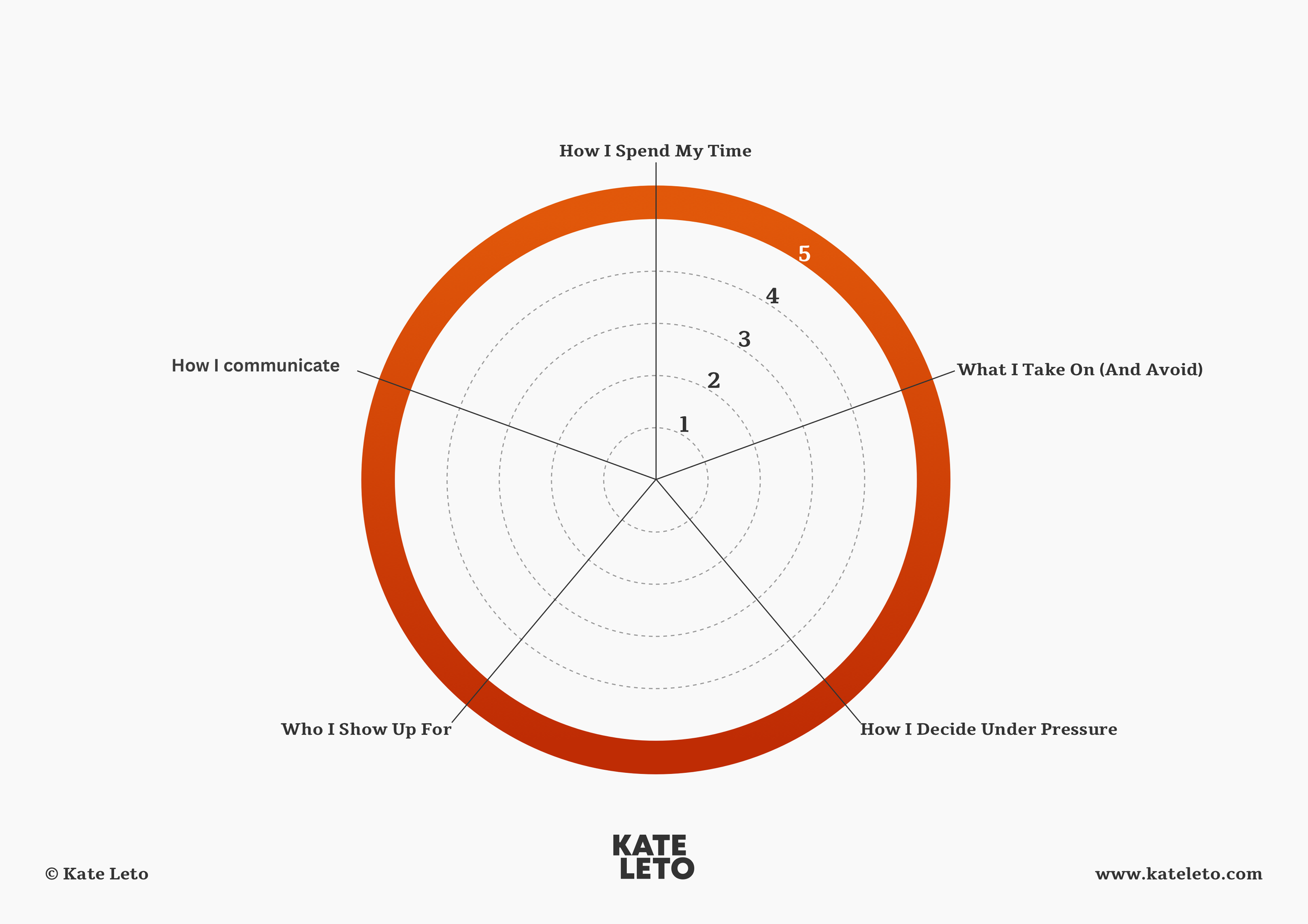
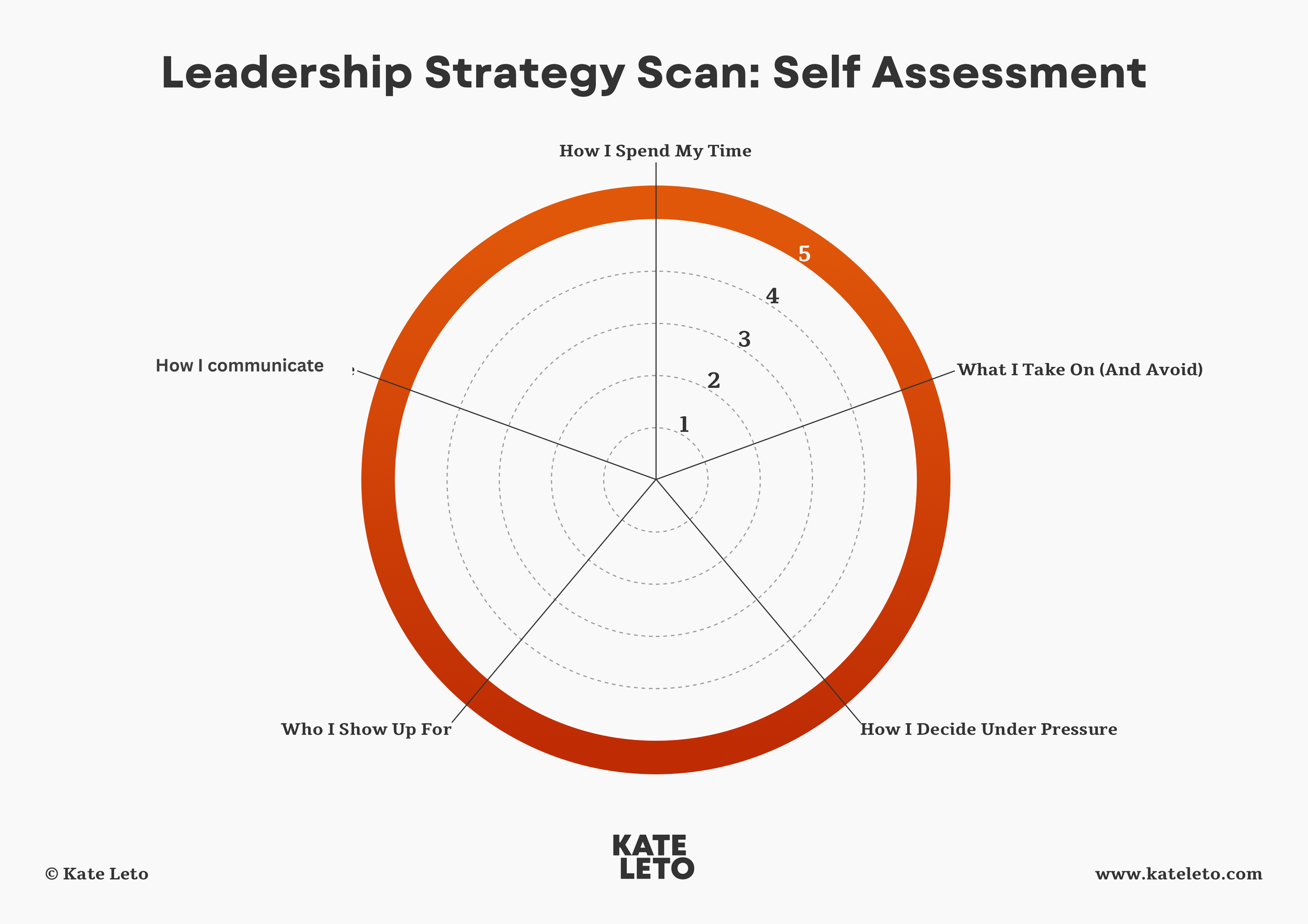
When you're done, plot your scores on the radar chart. You're not looking for a number to improve. You're looking for the shape — and for what that shape tells you about your pattern.
The Five Dimensions
1. How I Spend My Time
Your calendar is full, and it’s been full for months. Three of today’s meetings could have been an email. A team member has asked twice for a development conversation that keeps getting rescheduled. There’s a strategic question that needs your thinking but you haven’t found a clear hour to sit with it. By Thursday you’re exhausted and unclear on what you actually moved forward.
This dimension looks at where your energy and focus actually go — not where you intend them to go.
When the pace of change accelerates, reflection and development get squeezed first. Strategy gets replaced by reaction. A leader’s time stops reflecting their priorities and starts reflecting their anxiety. That’s one of the earliest signs of being off script — and one of the easiest to miss, because staying busy feels like staying on top of it.
Rate yourself on how intentionally you’re managing your time and energy right now:
Rating 1 — I’m constantly in motion. My calendar is packed with demands that feel immediate. I rarely make time for reflection, strategy, or developing my team. I’m reacting more than leading.
Rating 3 — I carve out space for what matters, but the most pressing things still hijack my week more than I’d like. I know where I want to focus — I’m just not consistent yet.
Rating 5 — I’m intentional with my time. I protect space for deep thinking, coaching, and strategic work. My calendar reflects my priorities, not just the loudest demands on it.
2. What I Take On — and What I Let Go
A problem lands that technically belongs to someone on your team. You could hand it back. Instead you find yourself working on it at 10pm. Or the opposite — something genuinely needs your attention and you keep finding reasons to stay at a distance. Either way there’s a cost, to you and to the people around you.
This dimension is about how you respond to the work around you — not just what you take on, but why.
Are you stepping in out of genuine ownership? Or because letting go feels risky, or because stepping back feels like abandoning something you’re not sure anyone else can handle? Under pressure, most leaders default to one of two patterns: doing too much, or pulling back entirely. Both are understandable. Both compound over time.
Rate yourself on how consciously you’re choosing what to own and what to let go of right now:
Rating 1 — I take on too much, even when it’s not mine to own. Or I disengage when I feel overwhelmed. Either way I often end up resentful or stuck.
Rating 3 — I’m starting to notice the pattern. I delegate when I can, but I still wrestle with letting go — or knowing when stepping back in is the right call.
Rating 5 — I have a clear sense of what’s mine to own. I choose where to engage and when to hold back. I create conditions for others rather than doing it for them.
3. How I Make Decisions When the Pressure Is On
You’re in a leadership meeting. A proposal lands — a structural change, a new AI initiative, a resourcing decision that will affect a significant part of the organisation. You’ve had limited time with the information. The room is waiting. You feel the pull to decide — or to defer — before you’ve actually got clear.
This dimension looks at how you make decisions when the pressure is on and time is short.
It’s one of the areas I see most directly disrupted right now. The volume of decisions has increased and the time to make them has compressed. The information is noisier and harder to interpret, yet the consequences — for teams, structures, and the people inside them — can be larger than they’ve ever been. In that environment it’s worth asking honestly: are you deciding from clarity, or from the pressure in the room?
Rate yourself on how grounded your decision-making is when the stakes are high:
Rating 1 — I freeze or rush. I overthink, or I move fast just to keep things moving. The fear of getting it wrong — or of being seen not to know — often drives me more than I’d like to admit.
Rating 3 — I’m sometimes grounded, sometimes reactive. My stress level shapes how I decide more than I’d like.
Rating 5 — I make decisions with clarity and intention. I can hold ambiguity without pretending to more certainty than I have — and without letting the absence of certainty become a reason not to act.
4. How I Communicate When I Don’t Have the Answer
Your team is asking directly what’s happening with the restructure, the new strategy, the AI initiative that everyone has heard rumours about. You’ve been in three leadership meetings this week and come out of each one less certain than you went in. You don’t know what to tell them. You feel the pressure to say something — but you’re not sure what’s true yet.
This dimension looks at what you actually do in the gap between not knowing and needing to communicate.
It’s one of the most visible places a leader goes off script — and one of the least talked about, because the failure modes are easy to rationalise. Projecting confidence you don’t have feels like strong leadership. Going quiet feels like discretion. But teams read both accurately. They feel the gap between what’s being said and what’s actually happening, often before the leader does. And that gap — more than the uncertainty itself — is what erodes trust.
Rate yourself on how honestly and clearly you communicate when you’re uncertain or under pressure:
Rating 1 — I default to one of two things: projecting more confidence than I have, or going quiet and hoping the moment passes. Either way, I’m managing how I’m perceived rather than actually communicating.
Rating 3 — I’m getting better at naming uncertainty, but I still feel the pull to have the answer before I speak. I sometimes leave people more anxious or confused than before I said anything.
Rating 5 — I can communicate honestly even when I don’t have the full picture. I say what I know, what I don’t, and what I’m doing about it. People around me feel more grounded, not less, when I speak into uncertainty.
5. Who I Show Up For
There’s a stakeholder you’ve been meaning to build a better relationship with for months. A peer you find difficult. A conversation you keep finding reasons to delay. Meanwhile there are two or three people you talk to every day — the ones who are easy, who get it, who don’t push back.
This dimension is about your map of influence. Where are you actively building trust and alignment — and where are you quietly contracting?
When organisations are under pressure, the instinct is often to retreat to familiar relationships. The harder ones — where trust hasn’t been built, where there’s friction, where the conversation might go somewhere uncomfortable — get quietly deprioritised. That’s when a leader’s influence shrinks without them noticing it happening.
Rate yourself on how intentionally you’re investing in the relationships that matter right now:
Rating 1 — I stick to the people I feel comfortable with. I avoid tension or the relationships that feel unfamiliar or difficult.
Rating 3 — I know relationships matter, and I try to show up — but not always with intention or consistency.
Rating 5 — I actively invest in trust and alignment, including in the relationships that feel harder. I seek honest input, give real feedback, and ask clearly for what I need.
What Your Radar Is Telling You
Plot your five scores and look at the overall shape before you start analysing individual dimensions.
A contracted radar — scores clustering low across the board — often points to a leader running on depletion. The issue isn't any single dimension. It's the cumulative weight of leading without enough recovery, reflection, or support.
A jagged radar — high in some areas, significantly lower in others — often points to a leader whose strengths are compensating for the areas they're avoiding. That works for a while. It tends to show up under pressure.
Here's what a completed radar might look like:
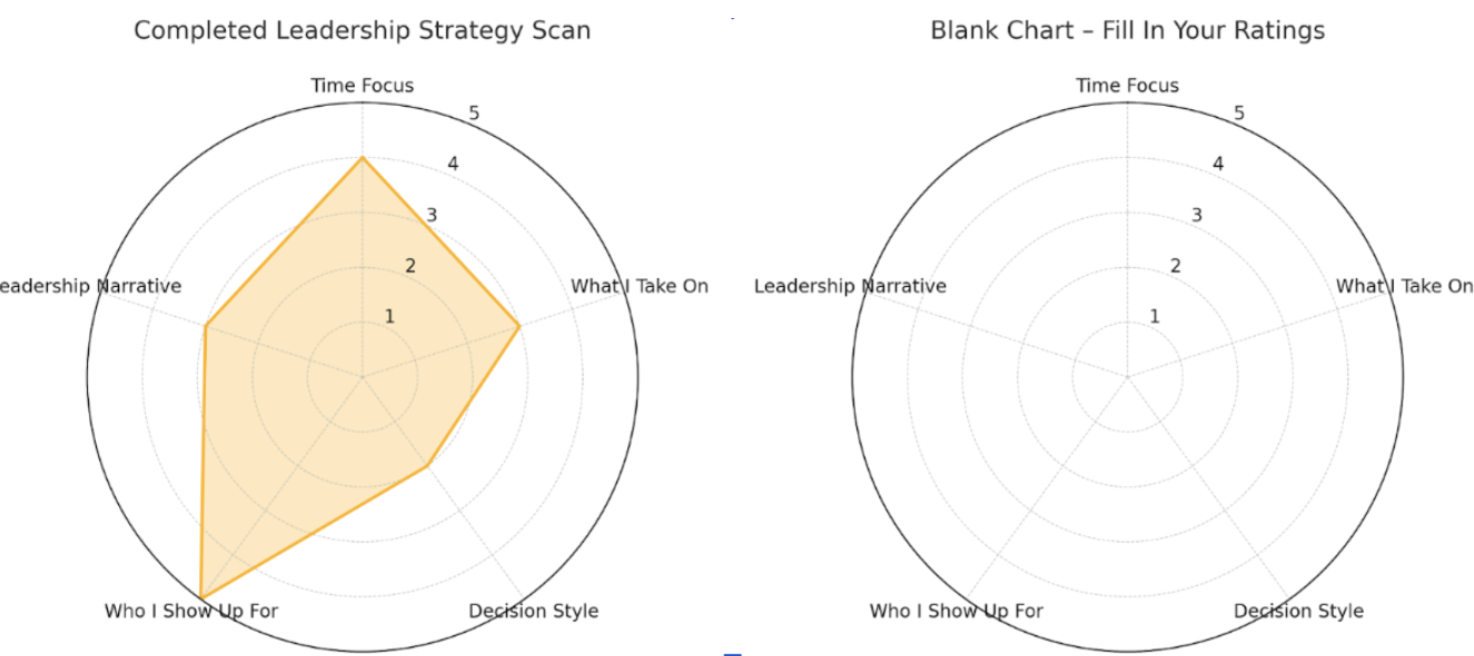
This example uses dimension names from an earlier version of the scan, but the principle remains the same.
Notice the shape. This leader scores high on time management (4.5) and relationship-building (4.5) — they're protecting space for strategic work and actively investing in key relationships. What I Take On sits at a 3, showing some awareness but inconsistency around delegation and ownership.
But Decision Style drops to a 2. That's the bottleneck. This leader has carved out the time, built the relationships, and is starting to let go of the wrong work — but when the pressure hits and a decision needs to be made, they freeze or rush. The other strengths can't compensate for unclear decision-making. That's where the pattern breaks under pressure.
Now look at your own pattern. Not each dimension separately — the shape they make together. Because the pattern is telling you something about the story running underneath it. The story about who you need to be as a leader, and what you can't afford to be seen as.
Use these prompts to move from awareness into action:
Which dimension feels most out of sync with how you want to lead?
Think about a recent moment when you felt off script. Which dimension was most active?
What is one specific, small thing you could do differently in the next two weeks? Not a transformation — a deliberate shift.
How will you know something is changing? What would you notice first — in yourself, or in the people around you?
Then make one concrete commitment. A conversation you'll have, a habit you'll interrupt, a space you'll protect and write it down.
The scan is most useful as an ongoing practice — something to return to before a high-stakes moment, after a decision that didn't sit right, or when you notice you're feeling more reactive than usual. Come back to it in 30 days — not to measure progress, but to notice what's shifted, what hasn't, and what you understand now that you didn't before.
Try the Scan in Real Time
I'm running a small-group virtual test run of this scan on Tuesday, May 28th (9AM PT / Noon ET / 5PM BST / 6PM CET) ahead of delivering the full workshop at the Mind the Product Leadership Forum in June 2026.
It's 90 minutes, limited to 6-8 people, and free — but I need your honest feedback on what lands and what doesn't. You'll walk through the scan, work in small groups, and design one shift to test immediately. Plus a follow-up call after the workshop to debrief what you learned.
If you're curious what your pattern looks like — and willing to help me refine this before the London event — sign up here.
