
Say It Now or Pay Later: The Conversation You're Not Having Is Costing You
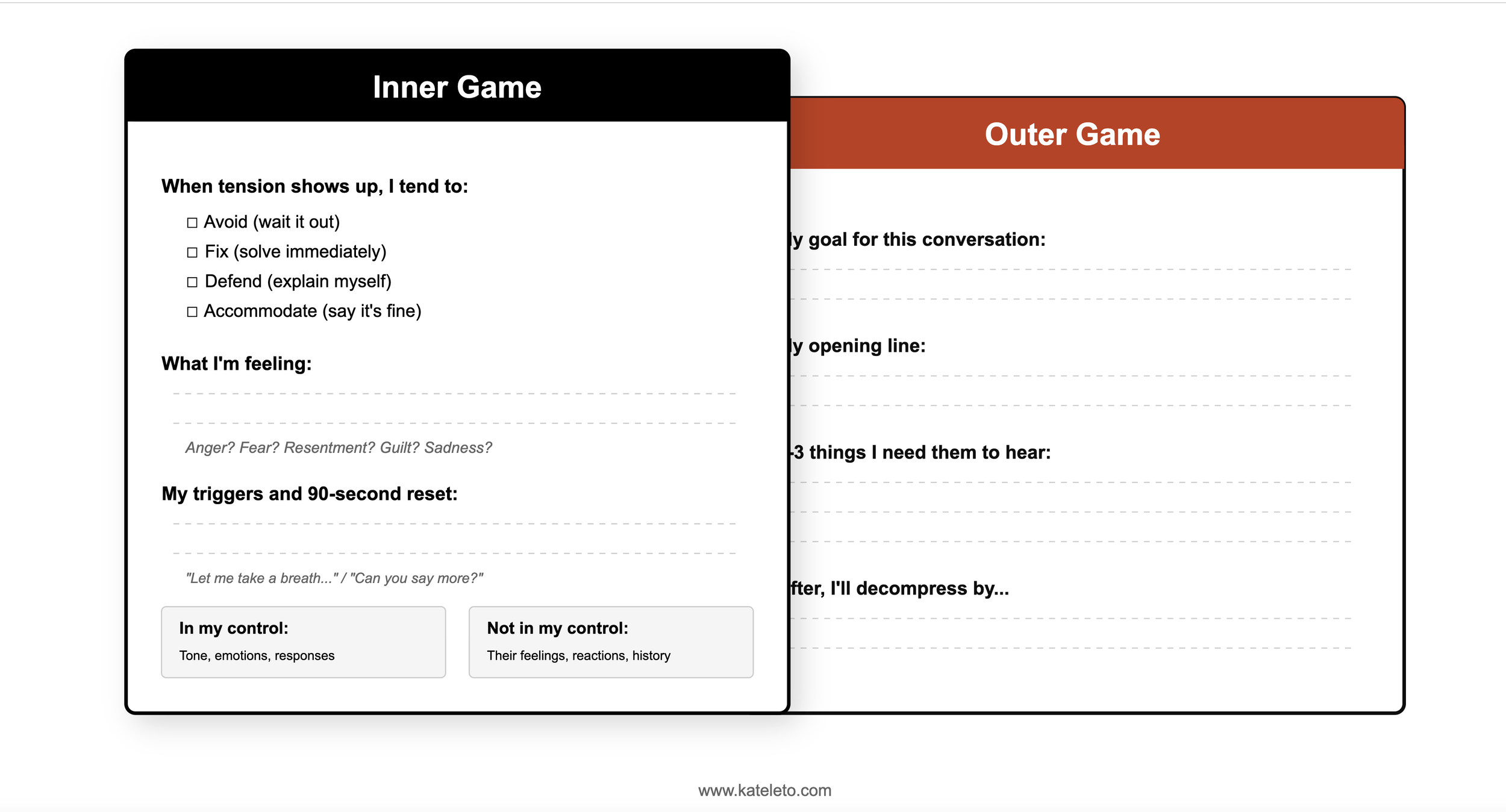
The Difficult Conversation Canvases maps the Inner Game (what's going on inside you) and the Outer Game (what's happening between you and another). Download it below to prepare for the conversation you've been avoiding.
Right now, who are you avoiding a conversation with?
In a recent workshop, I asked this question. What surprised me: most people weren't avoiding their boss or difficult colleague. They were avoiding someone outside of work—a partner, a family member, a friend.
Here's what that tells me: We've separated "work conversations" from "life conversations" as if they're different skills – but they're not. The way you handle conflict with your co-founder when they question your judgment, that's the same pattern you learned at your dinner table growing up. The defender, the fixer, the person who goes silent—these aren't work masks you put on. They're you.
Which means that the conversation you're avoiding with your teammate about the Q1 roadmap isn't really about the roadmap. It's about the same thing that's always been hard for you: being challenged, disappointing someone, admitting you don't have answers.
The Real Cost of Waiting
When you avoid that conversation, you're not just postponing discomfort. You're compounding it.
Every day you don't say something, the story you're telling yourself gets more elaborate, more justified. Meanwhile, the other person is creating their own story about your silence. The space between you fills with assumptions, misinterpretations, and missed opportunities.
By the time you finally have the conversation—because you will, eventually—you're not just addressing the original issue. You're addressing months of accumulated narrative.
This is what I mean by "pay later."
The Two Games You're Already Playing
So how do we stop paying? It starts with understanding that there are two games happening simultaneously in every conversation that matters. Drawing from Timothy Gallwey's concept in The Inner Game of Tennis:
The Inner Game: What's going on inside you
The Outer Game: What's happening between you
Most people jump straight to the outer game. Fix the thing, solve it and hope to simply move on. But the inner game always sabotages it. Because you can't solve what's between you if you haven't figured out what's within you.
““You can’t solve what’s between you if you haven’t figured out what’s within you.””
Your Pattern Was Installed Early
Your patterns around difficult conversations have most likely been with you for a long time—probably since childhood. You watched how conflict was handled, or wasn't; you learned what was safe and what got you shut out.
I see four patterns dominate in my work with leaders and leadership teams:
The Avoider: "If I don't acknowledge the conflict, maybe it will just disappear."
The Defender: "Conflict means I'm under attack, so I come out swinging."
The Accommodator: "I'll do anything to make this okay." But in making everyone else comfortable, you disappear.
The Fixer: "Let me just solve this and we can move on." (That's me—my family literally called me "the fixer.")
These aren't personality types. They're survival strategies. They made sense once, but now they're often in your way.
And they show up loudest when something specific triggers you: authority figures telling you what to do, ambiguity everywhere, or being ignored. Just noticing your pattern and what triggers it changes the game. Because once you see it, you can catch it before it catches up with you.
One Tool From Each “Game”
Let me give you one practical tool from each game that I use consistently with clients:
From the Inner Game: The 90-Second Reset
When you get triggered, your limbic system hijacks your prefrontal cortex. You literally lose access to rational thinking. Research shows this physiological response peaks and starts to subside within about 90 seconds—if you can avoid re-triggering it.
Which means buying yourself 90 seconds can help you get back online. Here's how:
Say: "I need to take a breath before I answer."
Or ask: "Can you say more about that?" (This buys you time while you're coming back online, and you might actually hear something useful.)
Or if you need more: "I need to step outside for a minute."
My clients especially resist that last one. Taking a break feels like giving up or losing control. But I always ask: Would you rather step away for 90 seconds and come back online, or have the other person experience you fully flipped out?
From the Outer Game: Separate the Person from the Problem
When things feel personal in the conversation—and they will—use this phrase: "This isn't about you or me. It's about X."
This isn't about you or me, it's about the Q1 roadmap. This isn't about you or me, it's about how we're structuring the team. This isn't about you or me, it's about the budget constraints.
One small phrase. It takes the heat out of what's becoming personal without losing the honesty of what you need to focus on.
The Structure That Actually Helps: The Difficult Conversation Canvases

The Inner Game Canvas
Designed to help you understand what’s happening inside of you when it comes to difficult conversations.

The Outer Game Canvas
Designed to help you prepare for a specific difficult conversation.
These are just two techniques from a larger framework I use with clients. I've taken Gallwey's inner and outer game concept and applied it specifically to difficult conversations in a set of tools called the Difficult Conversation Canvases. They walks you through:
Identifying your pattern and triggers
Preparing for specific conversations
What to do during the conversation
How to take care of yourself after
It's not magic. But it gives you structure when everything feels overwhelming—a starting point with tools and techniques you can adapt to your needs and style.
After years of coaching leaders through these conversations, almost everyone tells me: "It wasn't as bad as I thought it would be." The anticipation is always worse than the reality. And having a framework? It turns the unknown into something you can navigate.
Download the free Difficult Conversation Canvases here
Want to go deeper? I walk through the full framework—inner game, outer game, and everything in between—in my webinar "Say It Now or Pay Later." Watch the webinar here.
I work with senior leaders and leadership teams on the human side of their work—the tensions, messy relationships, and conversations they'd rather avoid but can’t afford to. If you're facing a situation that feels impossible, let's talk.
Follow me on LinkedIn for more insights on navigating difficult conversations and the relational dynamics that actually matter in leadership.
